



The Difference Between Risk Tolerance and Risk Capacity
Investors often describe their comfort with risk in general terms. Some say they are comfortable with volatility. Others say they prefer stability. These descriptions are useful starting points, but they may not capture the full picture.
Risk tolerance and risk capacity are two distinct concepts. Understanding the difference between them may help investors make more informed decisions about how their portfolios are structured.
What Risk Tolerance Means
Risk tolerance refers to an investor’s emotional and psychological ability to withstand fluctuations in portfolio value. It reflects how an investor feels when markets decline.
Some investors experience significant discomfort when account balances drop, even temporarily. Others remain relatively calm during periods of volatility. These reactions are personal and may be shaped by past experience, financial knowledge, and individual temperament.
Risk tolerance is often assessed through questionnaires that ask how an investor would respond to hypothetical market scenarios. The answers may help indicate whether an investor is more comfortable with conservative, moderate, or aggressive allocations.
However, risk tolerance is not static. An investor who felt comfortable with volatility during a long bull market may feel differently after experiencing a sharp decline. What investors believe they can tolerate in theory may change when faced with real-world market declines.
What Risk Capacity Means
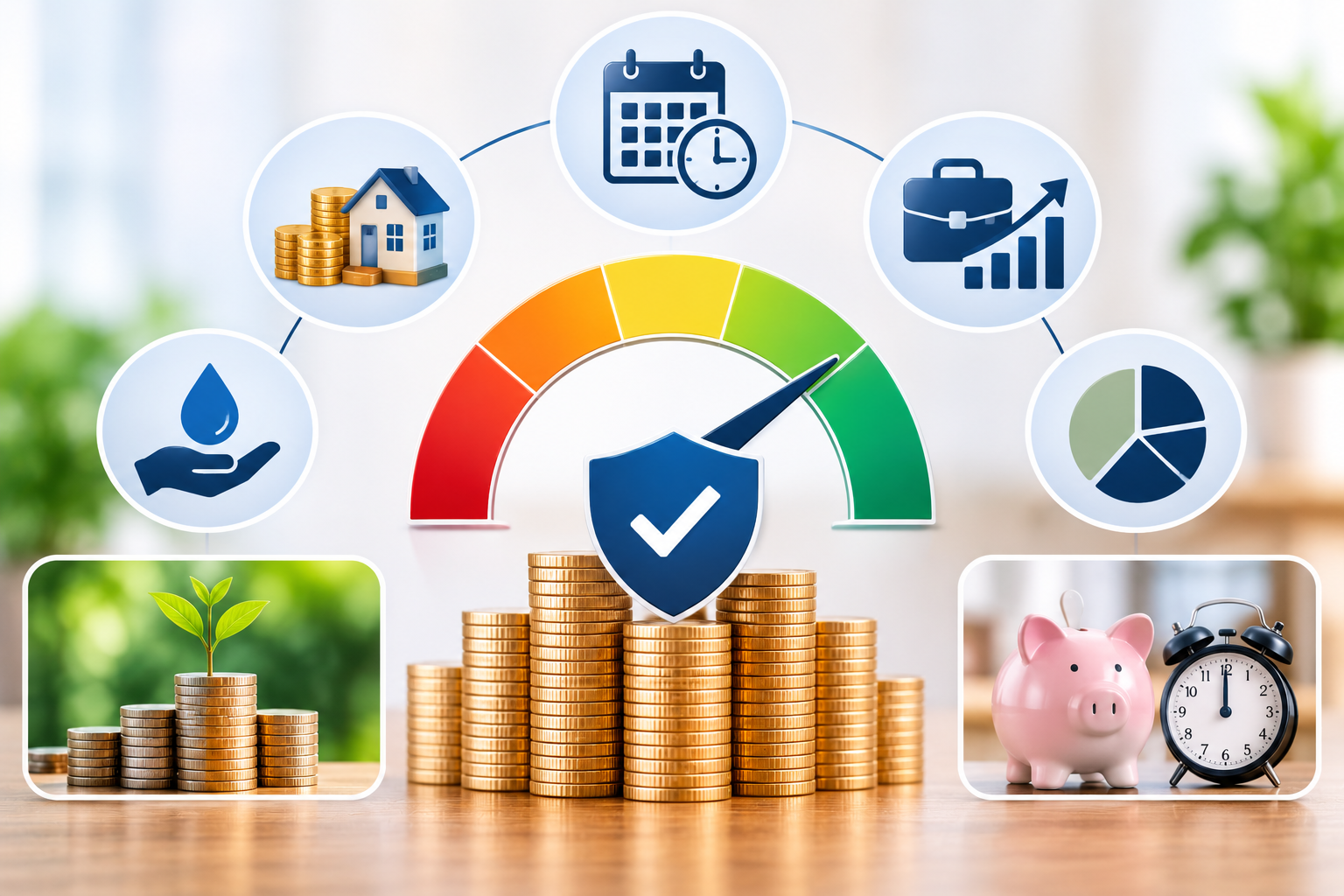
Risk capacity refers to an investor’s financial ability to absorb losses without jeopardizing long-term goals. It is determined by objective factors rather than emotions.
These factors may include:
- Time horizon before funds are needed
- Total assets relative to financial obligations
- Income stability and earning potential
- Liquidity needs and access to other resources
- The proportion of wealth represented by the portfolio
An investor with a 30-year time horizon, stable income, and diversified assets may have high risk capacity regardless of how that investor feels about market swings. Conversely, an investor approaching retirement with limited savings and fixed expenses may have low risk capacity, even if that investor is emotionally comfortable with volatility.
Risk capacity is based on financial circumstances. It addresses the question: how much loss could this investor potentially sustain without derailing financial goals?
Why Both Concepts Matter
Portfolio construction typically considers both risk tolerance and risk capacity. When the two are aligned, the process is relatively straightforward. An investor who is comfortable with volatility and has the financial capacity to absorb it may be appropriately positioned in a growth-oriented portfolio.
When the two diverge, decisions become more complex.
Consider an investor with high risk capacity but low risk tolerance. This investor may have decades until retirement and stable income, but feels anxious during market downturns. A highly aggressive portfolio might be consistent with the investor’s capacity, but if the investor sells during a decline, the portfolio may not reflect the long-term strategy it was designed to follow.
Alternatively, consider an investor with low risk capacity but high risk tolerance. This investor may be comfortable with volatility, but the financial situation does not support significant losses. Taking on too much risk could compromise near-term obligations or long-term security.
In both cases, the portfolio decision involves weighing competing considerations rather than optimizing for a single variable. This is one reason why personal asset management involves more than selecting investments based on projected returns.
How These Concepts Apply in Practice
Chicago investors face the same considerations as investors elsewhere, though individual circumstances vary. Some may be accumulating wealth during peak earning years. Others may be transitioning toward retirement. Some may have concentrated positions in a single company or sector.
At Virtue Asset Management, we consider both dimensions when working with clients on portfolio decisions. Understanding where an investor falls on each measure may help shape how portfolios are constructed and how conversations unfold during periods of market stress.
When evaluating an investment adviser, understanding how a firm evaluates risk may be part of the selection process. Some approaches emphasize risk tolerance questionnaires. Others incorporate financial modeling to assess capacity. Some consider both.
Evaluating Both Dimensions
Investors evaluating their own portfolios may wish to consider several questions:
- Is the current allocation based on financial circumstances, emotional comfort, or both?
- Has the time horizon or financial situation changed since the portfolio was last reviewed?
- During past market declines, was the response to stay the course or to make changes?
- Are there upcoming liquidity needs that would be affected by a significant decline?
These questions do not have universal answers. What matters to each investor may vary based on goals, circumstances, and preferences.
The Role of Ongoing Review

Risk tolerance and risk capacity may both evolve as circumstances change. A portfolio that was appropriate five years ago may no longer align with current realities. Life events, market conditions, and shifting priorities may all warrant a fresh evaluation.
At Virtue, these conversations are part of the ongoing advisory relationship. We reach out to clients quarterly to offer a review meeting, which provides an opportunity to revisit these considerations rather than setting an allocation once and leaving it unchanged.
Conclusion
Risk tolerance and risk capacity are related but distinct concepts. One reflects how an investor feels about volatility. The other reflects what an investor may sustain without compromising financial goals.
Portfolios constructed without attention to both dimensions may create challenges over time. An investor who takes on more risk than the financial situation supports may face difficult choices during a downturn. An investor who takes on more risk than emotional comfort allows may abandon the strategy at the wrong moment.
Virtue Asset Management is an independent, fee-only investment adviser registered with the U.S. Securities and Exchange Commission. Registration as an investment adviser does not imply any particular level of skill or training. The firm provides investment management and financial planning services, including evaluation of risk considerations as part of ongoing advisory relationships. Not all services are available to all clients, and services are provided pursuant to the terms of each client’s advisory agreement.
Contact us or call (312) 778-8707.
Disclosure: This material is provided for general informational and educational purposes only and should not be construed as individualized investment, tax, accounting, or legal advice. Investing involves risk, including the possible loss of principal. No investment strategy can guarantee a profit or protect against loss. The appropriateness and potential consequences of any investment, tax-sensitive, or financial-planning strategy depend on a client’s individual circumstances. Virtue Asset Management does not provide tax, accounting, or legal advice. Clients should consult the appropriate tax and legal professionals. For more information about Virtue’s services, fees, and conflicts of interest, please review our Form ADV Part 2A, available through the SEC’s Investment Adviser Public Disclosure website at https://adviserinfo.sec.gov/firm/summary/283438 or upon request.